Total Pageviews

Saturday, February 8, 2014

FOOLS WITH TOOLS


This is stupider than plowing half of the runway.  Don't plow any of it.  This has all the appearances of intentionally wanting to damage an aircraft.


Just do a doughnut off the end of the runway and leave mud all over the runway.  Idiots!!!!!


An then leave mud and turf on the runway from the previous fiasco. 


FAA EXTENSION


Friday, February 7, 2014

Mayor Blum stated he did not believe we spent any funds, that Air Evac spent their own funds.

The following relates to what is true and what is not true concerning content on this blog.   The FAA is clear on certain elements of aviation; a pilot must obtain “all pertinent information” concerning the weather, airports, equipment, and physical conditions, when planning a flight.   To make statements about the airport without all the pertinent information is reckless, and irresponsible.   Something that could ground a pilot.   It is very clear that statements are made by the city or the mayor concerning the airport without all the pertinent information. 

The following is from the public comment period of the Dec 17th 2012 meeting. 

 Mr. Dempsey asked if airport funds were spent fixing the facility for Air Evac and how much was spent. Mayor Blum stated he did not believe we spent any funds, that Air Evac spent their own funds.  
If a person is going to make claims about how much money the airport is costing the city, it would make sense to at least look at the books.

What is interesting is that this is all blamed on the fixed wing tenants. No mention has ever been made as to what it cost to put Airevac on the field.  But if the fixed wing tenants want the runway plowed, well that's just to bad, we are only going to plow half of it.  


Let’s look at the airport expense from 2006, $23,298 is listed as expense for AirEvac.  Someone does not know what they are talking about.  
That $23,298 listed as an Air evac expesnse.
Other expenses that are chargeable to the Airevac project are listed in misc. and Repairs and maintenance.  
Other expenses include
Septic Services
pump out holding tank
110
Binks Trucking
rock and tractor time
260
Vision excavating
storm water, reil excavation asphalt cutting 12" riser, back-fill
9383.46
Paul Gross
wiring the sewer pump replace breakers
487
"
Install disconnect on FAA riel system
556
Central Missouri Septic
pumping disposal
480
Septic Services
pumping out tank
175
total
11451.46

All this was done for the AirEvac project.  That comes to $33,749.46 the city spent on AirEvac. 
This is at a time where Airevac is paying %1.4 of the airport income.  The fixed wing tenants were paying 98.6% of the airport income. 
But then again who is running the airport?  The mayor, and by his own admission does not know how to operate an airport.
“I am no aviation expert, and I am not a FAA guru”


Thursday, February 6, 2014

GRANT ASSURANCE 11 PAVEMENT MAINTENANCE


By not knowing this requirement, or ignoring it on purpose, constitutes non-compliance.  This Grant assurance is common knowledge among airport operators.  See 7.5 below.

11. Pavement Preventive Maintenance. With respect to a project approved after
January 1, 1995, for the replacement or reconstruction of pavement at the airport, it assures or
certifies that it has implemented an effective airport pavement maintenance-management
program and it assures that it will use such program for the useful life of any pavement
constructed, reconstructed or repaired with federal financial assistance at the airport. It will
provide such reports on pavement condition and pavement management programs as the
Secretary determines may be useful.
5190.6b
7.3. Grant Assurance 19, Operation and Maintenance. Grant Assurance 19, Operation and
Maintenance, is the most encompassing federal grant assurance related to airport maintenance.
It requires the sponsor to operate and maintain the airport’s aeronautical facilities – including
pavement – in a safe and serviceable condition in accordance with the standards set by applicable
federal, state, and local agencies. FAA pavement guidance applies.
7.4. Maintenance Procedures. Generally, airport agreements require the sponsor to carry out a
continuing program of preventive and remedial maintenance. The maintenance program is
intended to ensure that the airport facilities are at all times in good and serviceable condition to
use in the way they were designed. Advisory Circular (AC) 150/5380-7A, Airport Pavement
Management Program, discusses the Airport Pavement Management System (APMS) concept,
its essential components, and how it can be used to make cost-effective decisions about
pavement maintenance and rehabilitation. The airport agreement may express or imply such
maintenance requirements and include specific federal obligations such as:
a. Frequently check all structures for deterioration and repair.
b. Inspect runways, taxiways, and other common-use paved areas at regular intervals to ensure
compliance with operational and maintenance standards, to prevent progressive pavement
deterioration, and to make routine repairs such as filling and sealing cracks.
c. Inspect gravel runways, taxiways, and common-use paved areas at regular intervals to ensure
compliance with operational and maintenance standards, to prevent progressive deterioration of
operation areas, and to make routine repairs including filling holes and grading.
d. Inspect turf airfields at regular intervals to ensure there are no holes or depressions, and
otherwise to ensure that all turf areas are preserved through clearing, seeding, fertilizing, and
mowing.
e. Maintain field lighting and Visual Approach Slope Indicators (VASIs) in a safe and operable
condition at all times. When conditions dictate, realign VASIs on a regular basis.
f. Maintain airfield signage in a safe and operable condition at all times.
g. Frequently inspect segmented circles and wind cones to ensure accurate readings and proper
functioning.
h. Frequently inspect all drainage structures including subdrain outlets to ensure unobstructed
drainage.
i.                    Frequently check all approaches to ensure conformance with federal obligations.

7.5. Criteria for Satisfactory Compliance with Grant Assurance 19, Operation and
Maintenance.
Although an acceptable level of maintenance is difficult to express in measurable units, the FAA
will consider a sponsor compliant with its federal maintenance obligation when the sponsor does
the following:
a. Fully understands that airport facilities must be kept in a safe and serviceable condition.
b. Makes available the equipment, personnel, funds, and other resources, including contract
arrangements, to implement an effective maintenance program.
c. Adopts and implements a detailed program of cyclical preventive maintenance adequate to
carry out this commitment.
7.6. Airport Pavement Maintenance Requirement. A parallel assurance to Grant
Assurance 19, Operation and Maintenance, is the airport sponsor’s federal obligation to maintain
a pavement preventive maintenance program under Grant Assurance 11, Pavement Preventive
Maintenance. This assurance requires sponsors with federally funded pavement projects for
replacement or reconstruction approved after January 1, 1995, to implement an effective
pavement maintenance and management program that runs for the useful life of any pavement
constructed, reconstructed, or repaired with federal financial assistance. The program, at a
minimum, must include (a) a pavement inventory, (b) annual and periodic inspections in
accordance with AC 150/5380-6B, Guidelines and Procedures for Maintenance of Airport
Pavements, (c) a record keeping and information retrieval system, and (d) identification of
maintenance program funding.
d. Pavement Recordkeeping. Complete information concerning all inspections and
maintenance performed should be recorded and kept on file. The severity level of existing
distress types, their locations, their probable causes, remedial actions, and results of follow up
inspection and maintenance should be documented. In addition, the file should contain
information on potential problem areas and preventive or corrective measures identified.
Records of materials and equipment used to perform all maintenance and repair work should also
be kept on file for future reference. Such records may be used later in identifying materials and

remedial measures that may reduce maintenance costs and improve pavement serviceability.

WHAT? THEY DON’T READ THE MAIL


The following statements are from the Jan 7th 2013 council meeting concerning the pavement.

• Conducting adequate repairs and the regular inspection of pavement surfaces.

“Mayor Blum stated he would like to tell the Alderman and the audience exactly what he knows and far as these actions to date. This portion of the corrective action is completely new to himself and Administrator Childers. This is another item that has never been on any type of documents that we can see, as far as we know. Mayor Blum asked Administrator Childers if he was aware anything concerning pavement surfaces. Administrator Chiders stated no, not that has been mentioned in any of the documents filed so for”.

The city was advised of the pavement conditions in 08, and 09.   The 09 letter refers to items from previous inspections, and show that these seem to be a repetitive situation.  


FORCE THE TENANTS OFF THE AIRPORT

These are comments from the Jan 7th  2013 meeting.


Mayor Blum stated you have before you 2009, 2010, 2011 and 2012 documentation, in front of you, that shows all revenue and all expenses. Mayor Blum stated the only thing we can determine is the fact that they want us to go out and physically open a separate checking account. Administrator Childers stated that is the only thing I can read into it, it is already maintained by a separately identified managed fund and noted by the auditor as a separate fund, and it’s as separate a fund as you can get and that doesn’t seem to be enough. Alderman Fuchs stated, so the auditor is approving this system and they are requesting that we maintain that facility with additional banking, additional bookwork, and additional staff time to manage this in a separate
account. Mayor Blum stated that is correct. Administrator Childers stated it’s possible they simply don’t understand anything about accounting and if we have it in a separate bank then maybe they will understand that. Mayor Blum stated maybe it is just their procedure.  Mayor Blum asked if there were any other items the Board would like to discuss, but it would be his recommendation to the Board that we once again do what they ask us to do, we have done this all along, and at some point there has to be foul cried on our part, we are doing everything they are asking us to do, including this here.


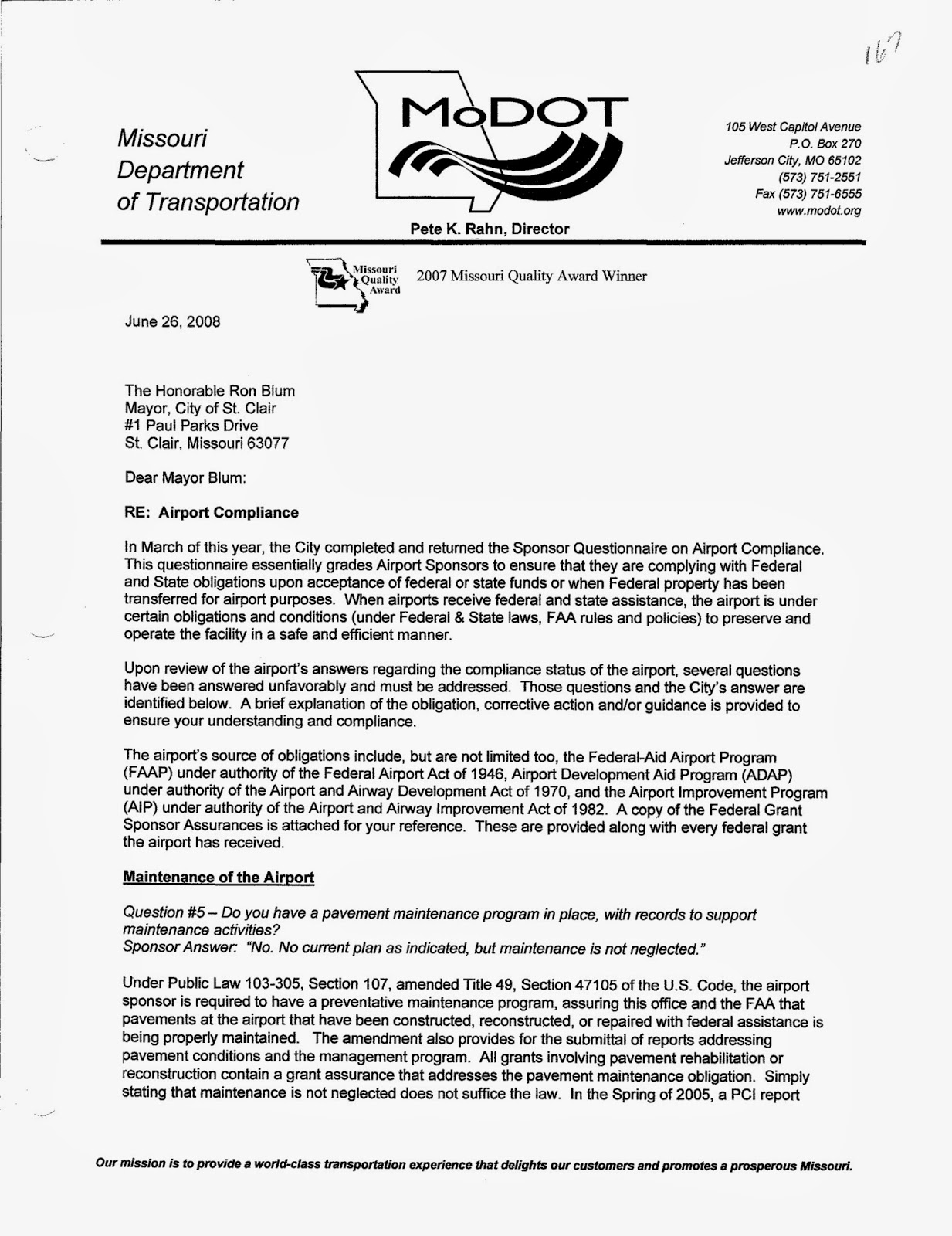
Let’s look at a letter from the city to MoDOT dated July 1st 2008.  I refers to a letter from MoDOT dated June 13th 2008. 

The city was told in 2008 to put the airport funds in a separate account. 
In 2013 Blum states;  Mayor Blum asked if there were any other items the Board would like to discuss, but it would be his recommendation to the Board that we once again do what they ask us to do, we have done this all along, and at some point there has to be foul cried on our part, we are doing everything they are asking us to do, including this here.

FIVE YEARS go by and the city finally gets it.  

Also in the letter. 

Mr. Arndt makes the statement that the airport is finally not in deficit.  It also refers to declining revenues.  Why would revenues decline? Vacancies caused by high rental rates.  Let’s look at what the city put in their “fact book”.

The City has no intention to expand the current level of these terminal area facilities and services, and the cost of those capital improvements to these areas that are absolutely required will be passed along to the tenants as increases in monthly rental rates and charges. All hangar leases at the Airport expire at the end of calendar year 2010; the lease with Air Evac Lifeteam extends to July 31, 2015. The net effect is that the based aircraft count at the Airport will decrease rapidly and will eventually fail to meet NPIAS eligibility criteria. The use of the
Airport by based and transient aircraft will similarly decline inasmuch as no ground services will be available and other area airports become more attractive for use.

Sounds like a plan to raise the rent a run off all the tenants. 


WHAT'S UNTRUE?

The mayor, Ron Blum, recently made the comment at the state of the city speech at the Chamber of Commerce meeting, about the blog.  He commented that everything on the blog was untrue.   Let’s look at one item, the city tried to raise the rent on the T-hangars to $300 a month in order to make the airport more self sustaining.  He also stated, “Again, the self-sustaining issue, it baffles me, I am no aviation expert, and I am not a FAA guru,” which kind of explains everything.  He is confused, and this comment demonstrates a violation of the grant assurances in itself.   What do the Feds have to say on this subject?
b. Preliminary assessment. FAA must make a judgment call in all cases as to whether a
sponsor is reasonably meeting its federal commitments. A sponsor meets its commitments when:
(1). The federal obligations are fully understood;
(2). A program (e.g., preventive maintenance, leasing policies, operating regulations, etc.) is in
place that the FAA deems adequate to carry out the sponsor’s commitments;
(3). The sponsor satisfactorily demonstrates that such a program is being carried out; and,
(4). Past compliance issues have been addressed.
Alderman Fuchs stated; “I do not know how you guys or anybody can file complaints at a federal level that destroys a community, but that is what has happened. To our City I apologize, I do not know what else to do; our hands are tied because of a small group of hobbyists. 
Alderman Fuchs’s comments insinuate that this expense the city is going to experience is the fault of the tenants.   The actions of the city council, due to its lack of understanding of its federal obligations are responsible for the federal intervention.   
He also stated, “To our City I apologize, I do not know what else to do; our hands are tied because of a small group of hobbyists.”   This statement is untrue, the city hands are not tied because of a few hobbyist; they are tied by the Federal Government.   This comment goes to show that Alderman Fuchs is as confused as the mayor.   
Alderman McGlenn responded they already pay $300 per month rent and they have an existing lease.  Alderman McGlenn said her feeling is similar to the ball field use, if you charge one person an amount of money, then the other people should pay the same amount of money. She continued, Air Evac is charged $300 per month to use the airport and the pilots for a hobby were paying $175.00 per month, if we are charging Air Evac who is doing a public service $300.00 per month and are locked into a contract until 2015, her opinion is that it is only fair to charge the pilots the same amount of money as Air Evac is being charged.
This statement by Alderman McGlenn demonstrates that she is as confused as the mayor, and has little or no understanding of the Federal Grant Assurances. 
What does the FAA state?
18.6. Local Negotiation and Resolution.
a. General. Although federal law provides the DOT with authority to intervene in disputes over
an airport fee or charge, the DOT primarily relies on the sponsor and its aeronautical users to
reach consensus on airport rates and charges. The sponsor may impose a fee unilaterally, after
consultation with users, if the fee is fully consistent with the Rates and Charges Policy. The
sponsor may adopt a fee that varies from the Rates and Charges Policy only if users agree.
b. Consultation. As provided for in the Rates and Charges Policy, DOT encourages adequate
and timely consultation with users prior to implementing rate changes. To permit aeronautical
users time to evaluate proposed rate changes, consultation should be well in advance, if practical,
of introducing significant changes in charging systems, procedures or level of charges. Adequate
information should be provided so users can evaluate the airport’s justification for the change
and to assess its reasonableness. Due regard should be given to the views of both the
aeronautical users and the airport and its financial needs. The Rates and Charges Policy notes
that the parties should make a good-faith effort to reach agreement, and encourages airports and
aeronautical users to include alternative dispute resolution procedures in their lease and use
agreements to facilitate resolution and reduce the need for direct federal intervention to resolve
differences over aeronautical fees.
c. Reasonable Distinctions. The prohibition on unjust discrimination does not prevent a
sponsor from making reasonable distinctions among aeronautical users (such as signatory and
nonsignatory air carriers) and assessing higher fees on certain categories of aeronautical users
based on those distinctions (such as higher fees for nonsignatory versus signatory air carriers).

What else did the FAA say?  They said the city was wrong, and told them to fix it.  They did not say the tenants were wrong.  The tenants did not get a letter from the Feds.  All of the Alderman should have apologized to the citizens of St. Clair for their actions that caused this mess.

The recreational, or hobbyist aircraft owners as the city like to put it, is a 2 billion dollar a year industry.  More homebuilt aircraft are purchased every year than factory aircraft.  The city would be wise to attract this market to their airport, since the business aircraft are not coming here.  What difference does it make as to what type of aircraft rents a hangar, homebuilt one seat aircraft, or a medical helicopter, if each one of them rents an identical hangar, the hangar rent according to the federal law must be the same.

What is the purpose of raising the t-hangar rent?  To get the tenants to move to another airport. 


Friday, January 10, 2014

This is soooooo stupid, I'm going to have to think about this one.


Sunday, January 5, 2014

A PILOT WALKS INTO A BAR!!!


Why would anyone write a news article about one pilot moving From St. Clair to Sullivan?    It’s not news. What is news is the controversy that it produces.  Ron Blum’s plan to run off all of the pilots in order to make it easier to close the airport is slowing down.  It actually kind of hit a derailment with Airevac.  Ron Blum was trying to get rid of the pilots, and instead got rid of the one of thing that St. Clarions were proud of.   Airevac left St. Clair after about 8 years, a now the city has no way to recover the cost of the improvements made to the airport to get Airevac to stay in the first place.   So, there is an article in the local news media about one guy moving his airplane to Sullivan.  BIG DEAL.  But the article also goes on to spout about the airport losing money every single year.   The article makes it clear, AUDITED CITY RECORDS; this comment by the city is delusional.  Why doesn't the city just explain the records?   Instead, the city has taken a course to show that the people making these allegations are misguided.  After all these records have been audited, how could this be true?  They have been audited and therefore they must be accurate.  Repeat this over and over again, but in regards to the facts, well just sidestep, brush off, change the subject, divert attention, bellow out irrelevant crap, do whatever it takes to divert attention to the truth.

The following is an example, and not the only one, of what the city started to do to the airport.

 Did the Auditor find in the airport records where the city charged the airport for 10 taillight bulbs on 4/12/07?  For what purpose does the airport need ten 1157 tail light bulbs?  

To catch this, one would have to know what 1157's are.  

The tenants did not have to look very hard to find this, once we got the information.  Getting the information was hard.  I required repeated request for records according to FAA regulations, intervention by the Missouri House of representatives, and the Missouri State Attorney General Office to get the airport records that are supposed to be made available to the public, in a manor prescribed by the U.S. Department of Transportation.  It took over two years to get this detailed information.  

No wonder MoDOT told the city that the airport could be self sustaining if it would just follow the rules.   Federal Law also requires a compliance audit to confirm that an airport sponsor is following the rules, when they receive a Federal Grant.   The Specifications for a compliance audit a very clear and detailed.  The audit states, that it did not identify any deficiencies in internal control over compliance…   It does not state how hard they looked. 
The continued reporting that the airport operates in the red according to audited, un-audited, or whatever kind of records you want to look at does not matter, a close look at the records will show other items charged to the airport, charges made to the operations of the airport, and not to capital improvements, charges to operations that were spent for Airevac, and being paid for by fixed wing tenants.  The airport records are in bad shape already, but when someone is intentionally trying to make them worse, does not show very well for the city.   
The point here is:  if the city cannot or does not wish to defend its record keeping, the next best thing is to attack the opposition.   This has been the SOP since 06, make it look like the airport tenants are bad people, and the airport is the down fall of the city financially.   Make it big, keep it simple, and tell it over and over and soon everyone will eventually believe it.  AH.


Saturday, January 4, 2014

CONCERNING THE NEWSPAPER ARTICLE.

I received an email from Mr. Domke on Thursday Jan 2nd.   The paper publishes on Friday mornings.  I did not check my email until Saturday.  I was going to reply to comment to the online article, but have decided not to do so.  In December, I received an email from the tenant that recently moved to Sullivan, which stated that the reason he was leaving, was due to the poor condition of the taxiway, the lack of fuel, and the high hangar rent.   St. Clair is $40 a month higher than similar surrounding facilities.   With four tenants, airport income will be around $8500 for 2014 with a rental rate of $175.  If the rate was competitive, as outlined by the FAA guidelines, the airport income could be $15,000.   This action by the city to keep hangar rates above market rates, to discourage full occupancy, demonstrates intent to not follow FAA guidelines.    
In September of 2010 MoDOT Aviation sent a letter to the city stating that “Based on the information provided by the City for their 2009 revenue and expenses for the airport, it is possible for the airport to sustain itself if management and operational practices were executed in accordance with Federal Aviation Administration guidelines and circulars and in compliance with federal grant obligations.  Our office is available to assist the City with any questions related to the airport and can provide FAA documents related to compliance with federal grant assurances.”   The FAA has stated repeatedly that the prime obligation of an airport sponsor is to operate the facility for the benefit of the aviation public.   The number of tenants on the airport will have no bearing on the decision by the FAA in regards to a plan submitted by the city to close the airport; if the city does present a plan.  The FAA has stated that there is no support for what the city has submitted so far, anywhere in the entire FAA organization.   The FAA has not lifted the hold on the closure issue due to a formal complaint, and an ongoing United States Department of Transportation Office of Inspector General Investigation of the airport management.    
The audited financial statements also show depreciation of a 1.6 million asset at the airport.  No one has stated what this was where it is, or when it was completed. 
The key element here is, if management and operational practices were executed in accordance with Federal Aviation Administration guidelines and circulars and in compliance with federal grant obligations.  Until the city understands this and realizes that the direction they have chosen to proceed is not going to get them what they want, the airport closure attempt will continue to sink into a quagmire that will end up costing the city and city taxpayers  more and more money.